Relativity and Gravity Demo
Posted on: January 14, 2016
I saw this video on Popular Science today and I had to share it . It seems to be a teacher in-service day showing how to demonstrate relativity and gravity. I almost didn’t play it because it runs close to 10 minutes. Really excellent and worth your time.
Teacher Resources for Sale
Posted on: January 5, 2016
 Some of you may have noticed I haven’t posted anything new in a while. I retired from teaching at the end of last year and went back into the engineering field selling industrial automation. I hope to be able to continue teaching at the community college, but I’m traveling a bit and that doesn’t fit well with 14 week courses.
In the mean time, I have tons of great books on math, physics, physics labs, and general education. I’d like to offer them to my followers here at a very reasonable price before I put them up for sale on eBay. I’m guessing, but I probably have at least 8 different Calculus textbooks, 12 Physics textbooks, 20 or 30 books on hand’s on activities and labs, some movies, and … well, I have a lot of stuff. Some have answer keys, student resources, yes, it’s endless.
I’m going to compile a list, if you are interested, use the contact me link. I’ll email you the spreadsheet as soon as it’s done. Also let me know if you are looking for something in particular. I’m thinking I’ll list prices for each book but if you want to bundle a bunch, make me an offer. Choose what you like, pay for the books and the actual shipping cost. I’m not looking to get rich, I’m interested in putting these into the hands of people who can use them. What I don’t sell after a couple of weeks will go on eBay. Please don’t be shy.
Back to School Stress
Posted on: August 4, 2014
 I’m getting grief from my wife. After 11 years of teaching, she’s starting to give me grief about my current career. She doesn’t like that we can’t take vacations anymore, not like we used to. She works all summer and I am finally not. I don’t make the money I used to make in sales, not even close. I’m not working in the summer and she’s heading off to work.
I’ve found a couple of articles about teachers going back to school, but they are mostly written for women teaching elementary school. Male teachers married to women who aren’t teachers – we need a support group. I need to talk about some of this, I’m stressed out. My wife is asking me about getting back into manufacturing sales. I don’t want to do that, I love what I do. If I can make it just 10 more years, I’ll should have a pension that pays me half my meager salary every year.
So I’m not stressed out about shopping for my classroom, putting up posters (I had kids do it the last week of school), or oversleeping.
Here’s what I am stressed out about:
- Just being ready to start teaching 6 different courses (2 are at the community college). Once again, I’m teaching a course for the first time, Trig/Pre-Calc. That means a lot more work, especially since I will be using Standards-Based Grading in the course. More importantly, having the mental focus to do all of it well.
- A lack of control – of who I have as students, the number of students in the class, the class schedule, having time for exercise and a healthy meal.
- The first couple of weeks are brutal on my body – finding time for bathroom breaks, teaching non-stop, talking until my throat is raw, being “on” at 8am, and teaching until 9pm on Mondays and Tuesdays.
- Back to school orientation where we learn about administrative changes, new paperwork, rule changes, and basically sitting too long doing nothing when I have a million things to do.
- Putting on long pants and shoes. Seriously, I’m going to look like one of those scratchy sweater kids for the first couple of weeks. I’m not sure my school clothes will fit. I’m sure I can teach in shorts and flip-flops, I’ll wear a shirt with a collar if that will help.
- Grading.
- Keeping my mouth shut when I want to chew out a lazy teacher for being beyond useless.
I’ve tried to get started on my lesson planning, and it helps a little, but I really need the routine to get underway. It’s kind of the same feeling before playing a team sport. You can practice all you want and you are nervous waiting for it to start, but once the whistle blows, you are in the zone and it all just clicks. Can I do this 10 more times?
- In: Assessment | Math
- Leave a Comment
 My year is almost over. I’m not complaining, but I felt the strain of teaching too many different courses (Honors Physics, AP Calculus, 2 Robotics & Engineering classes, and Algebra 2). Every day was a scramble to prep for class, make copies, and grade papers; it took away from the time I got to spend interacting with the students. Despite my insanity, I had a few notable successes. Here are just two:
Story #1
I recently got two emails from the mother of a student. Let’s call him Pete (no, it’s not his real name). If you had asked me the first quarter of the year, I would have told you Pete was going to fail Algebra 2. In fact, I was certain he was going to fail. The first email came about a month ago:
Good morning. Just wanted to thank you for helping Pete with tutoring. He has come home excited about getting better grades in yourclass. It is nice to see him working towards getting those “4’s”, and really wanting to keep his grade up. Thank you again for your time and encouragement.
And then just this week:
Good Morning, once again just want to thank you for helping Pete realize that with hard work he can “Master” things in math and life.I was proud to hear that even though he was not feeling well on Thursday, he found a way to make it to the school to take a quiz, he didn’t want youto think he was slacking.
Pete started staying after school for help one or two days a week for the last several months. Sometimes he would just work out problems on the board for an hour. Some days he took a quiz. I never forced him to stay, I didn’t do anything except set expectations and keep the bar high. Pete’s motivation developed as he starting mastering a single concept. Little by little he started to have some success. It was new to him, and he liked it. The final is two days from now, but Pete will pass the course.
Story #2
Let’s call this guy Paul. Paul was a royal pain-in-the-ass for the first half of the year. I don’t think Paul had ever had any success in math. He was a victim of “learned helplessness” and was often a belligerent student. Paul is planning on going into the union and didn’t see much need to do anything beyond basic math. It was pretty clear that if he was going to pass my class, it wasn’t going to be by much.
I didn’t give up on Paul, I made him work every class. It took a while, but he mastered a single concept. A little success made a huge difference in his outlook and after a short time, he mastered another concept. Then something truly amazing happened. Paul’s friends started asking him for help and his confidence started to grow. With only a few weeks of school remaining, the students in the National Honor Society were asking Paul for help. Whenever Paul was asked for help by his peers, I would make it a point of asking him how it felt. I’ll take some of the credit for Paul’s turnaround, but I know for a fact that if I used traditional grading methods, he would have never mastered anything this year and would possibly be doing it all again in summer school.
Epilog
I think if there is a moral to these stories it’s that students will rise to meet expectations. Set the bar low and they will easily reach it. Set the bar high and they will struggle, learn from their failures, and gain confidence in themselves. But consistency is important. If you start down the path to SBG and wavier or back down, you’ve permanently lowered the bar in the students’ eyes. Don’t do it.
Student Created Lab
Posted on: January 6, 2014
 I had been wanting to add a lab where the students determine friction on an inclined plane. Students seem to struggle with the complexity of the problem and I thought a good lab would help. I wasn’t really happy with any of the labs I found on the internet, but I also wasn’t really up for creating one of my own. (Having four preps really sucks the life out of your creativity.) What I decided to do was to put the kids into groups, give each group a variable inclined plane (exactly the one in the picture), a couple of blocks, and lab weights. On the board I drew the force diagram of the block on a plane being pulled upward along with the appropriate formulas. The goal of the lab is for the students to be able to calculate the coefficient of friction between the incline and the block.
I gave the class the following instructions:
“You are creating a lab for next year’s students. You are going to need to decide on the lab procedure, required data and graphs, and the analysis questions. You need to write up the procedure and the lab results, but I only want one per group. I am going to take the best parts of each of your labs and use it next year.”
I asked them to start with only a single block, but they could add another if they think it will improve the lab. We discussed setting the incline from 0 to 40 degrees in 10 degree increments. They are using their phone to take pictures to include in their instructions and write-ups. They have one more day and then the paperwork is all due at the end of the week. I’m hoping for work that is a step above their usual lab write-ups.
I’m thinking maybe I lied to them. I originally did want the students to create a lab for next years’ students, but I might just give next years’ students the same assignment.
Worthwhile Math Software
Posted on: October 12, 2013
- In: Math
- 2 Comments
 I started teaching yet another course a my high school this year, actually two other courses if you count teaching at the community college. In addition to Physics, AP Calculus, and Robotics & Engineering, I’m also teaching a section of Algebra 2. My fellow math teachers have been using Kuta Software for the past couple of years, but it didn’t have a Calculus module, so I never got to play. When I was assigned Algebra 2, I was given the license codes and found they now have a calculus module as well.
I’ve used other software in the past, but Kuta is just fantastic. I can create a custom worksheet for homework, quizzes, and tutoring in under a minute. Each section of problems has different options. For example, multi-step equations let you decide if there are variables on one or two sides, if they have to distribute once or twice or not at all. Each concept has lots of other specific controls, but you can also just use their Easy, Medium, and Hard problem selection button.
If you have a worksheet or quiz already made, just select a problem, hit the space bar, and the problem changes, but stays within the parameters you set. This is perfect for Standard-Based Grading where you need another quiz. Just open an old one, select each problem and space bar, and you have a brand new quiz. Of course it can also generate multiple versions at once.
I can go on and on. Visit their site at http://www.kutasoftware.com and look at the free worksheets. Then download the 14 day trial and play. I can’t say enough good things about this software. We purchased unlimited 3 or 5 year licenses for Pre-Algebra through Algebra 2, and a single license for Calculus. I wasn’t part of the purchasing, but it seems like there are more purchase options than are shown on the web page.
 Our school has added a number of iPad and Mac carts. The technology push is on and I’m not generally excited about it. You have to understand, I am the technology guy. I sold top of the line engineering software to the defense and manufacturing industry. I’ve presented technology solutions to the Secretary of Defense’s office, Senators, Congressmen, Admirals, Generals, and heads of fortune 500 companies. I am not afraid of technology, I love technology. I have an engineering degree; I can program in half a dozen computer languages, and I’m competent in 3-D CAD. But handing me an iPad and telling me to use it in class is like buying a 12-piece screwdriver set and hoping screws will suddenly get loose. It’s a solution in search of a problem.
It took a brain-storming session with my department head to realize I do have a screw loose, I have a problem that technology might just solve.
I have been really unhappy with lab reports. I’ve gone full circle with what I want from the kids. Here is a brief history:
- Year 1-2 – The students were required to have hard-bound composition notebooks. Students were required to type the report (3-4 pages) and the notebooks were graded. I had about 100 students – grading was a nightmare and the work was poor when it was even done. Many of my students didn’t have a computer or a printer a home.
- Year 3-4 – I changed over to one-page labs where the students would fill in responses as they went. They were much easier to grade, but the rigor was gone.
- Year 5-7 – Students purchased Carbonless Lab Notebooks. They were to record observations and show their work as they went through the lab. This never worked as planned. It was a constant battle to get them to only write in the lab notebook; they wanted their report to be neater, so they took notes on the handout. Reports were hard to read because I was reading a copy of unreadable students’ handwriting. Students didn’t like that they couldn’t edit, mistakes were to be crossed out.
It is time for a change, again. Maybe technology will by my answer this time.
Here is the plan as it currently stands (in my head). Students will be given a basic report layout on the Mac using iBook Author. They will build on the layout to construct a full lab report. Having the Mac in their hands during the lab will allow them to take pictures of the set-up and the results. Ideally, they will be able to record data directly into tables and turn it into graphs, charts, and anything they feel is appropriate. Reports will be turned in electronically. What they turn in will be a unique, well-documented report, hopefully of a much higher quality than I received in the past.
The down-side is quite significant. First, there is going to be a learning curve for iBook Author. Second, the students don’t have their own Macs, so the entire lab report will have to be created during class time. What was a one-day lab will probably turn into two or three days of class time. Third, I’ll have to figure out how to transfer data from the Vernier to the Mac. I’m hoping the quality the iBook reports will make up for the lost teaching time.
If you are a follower of this blog, you may have noticed I posted this entry and then promptly unposted it. I thought the software I saw demonstrated was called iBook, but I couldn’t find the application for the iPad. I spoke with my principal today and she confirmed that I had it right. However, the authoring app does not exist on the iPad, only on the Mac. When I went to download the app for my Mac, it said it needed to be running OSX 10.7.4 and I’m running 10.6.8. I tried to update my Mac but it says no update is available. I admit, I’m a bit confused. The tech guy from school is the one pushing the app, so I’m sure he will get everything taken care of once we are back. I was just hoping to spend some time this summer exploring this idea.
If this works out, I should have some really nice files to post here in about two months. I’ll let you know either way.
Sharing the SBG Wealth
Posted on: May 22, 2013
 I have a steady stream of teachers asking if I would be willing to share my SBG files and spreadsheets. My answer is always a qualified ‘yes.’
I have over 300 Physics quizzes, 200 AP Calculus quizzes, and various spreadsheets and other files. If I dumped all of those files on you without a detailed explanation, you would probably be overwhelmed and get nowhere. So what I ask is that anyone requesting my hard work do a few simple things:
- Go back and read over all of my SBG posts from the beginning. I spent hours on research and reading before being convinced SBG would work for me. I documented the how and why pretty thoroughly here.
- Ask me questions, as many as you want. I promise to answer promptly and thoroughly. Only with some discussion will SBG really start to make sense. You can’t buy in part way. As Yoda might say, “SBG – do or do not.” Sort-of doing SBG doesn’t work.
- Don’t make changes to the system without discussing it with me. After research and discussions with other teachers, I was able to avoid a lot of mistakes. I have tried many tweaks and made a number of incremental improvements each year. Don’t reinvent the wheel.
- As you implement this and come up with your own tweaks, add to the dialog here. I want to learn from your successes and failures.
- Once I provide you with my files, do not publish any of the questions. They came from textbooks, I do not own the rights to most of the questions, so I can’t give you permission to publish them.
That’s really it. I’ve done all the work for two courses, now it looks like I’m picking up Algebra 2 Honors next year. Time to start work on a third course.
Helping Hand Challenge
Posted on: March 17, 2013
 I did this engineering challenge last year, but it didn’t go the way I wanted it to. I provided the kids with a stick, about 25″ long as the basis of a reach device. My mistake was allowing them to split the stick in half. As a result, they all made a big scissor and then made some small modification to make it grip.
This year, I have added a whole new level to the challenge. The stick can not be cut, only drilled for brass fasteners. They are given a budget and each item has a cost. I made sure they can only purchase a single stick with their budget. Purchasing two of them will put them immediately over budget and cost them lots of points.
The challenge came from pbs.org/designsquad, they have a few things there worth looking at if you are into engineering challenges. I downloaded the information a while ago. Here is the link for the activity: http://pbskids.org/designsquad/parentseducators/resources/helping_hand.html
Here is how I modified the activity for use in my classroom: Helping Hand Challenge. If you use this, let me know what you add or change. I will be using this tomorrow. The scoring rubric is at the bottom.
Update: I’m still angry over how some of the kids approached this. A couple of the really lazy ones did nothing but complain for two days. At the last second, they purchased a foot of tape, wrapped it around the stick and then tried picking up the objects with the sticky tape. Naturally, I changed the rules so that can’t happen next year. Tape got very expensive. I also changed the grading to downplay the points earned for moving the object and increasing points for the design. Essentially, I changed the grading to reflect effort and creativity. With the change in focus, I will need to watch for students copying ideas.
To be fair, I had a couple excellent designs. Some were quite well thought out. I had one group use rubber bands at the tip to increase friction of the grabber. 
 It’s been a pretty mundane year. No drama, no great leaps, no alien invasion or Mayan apocalypse, pretty much the same stuff, new year.
Hey, this would be a good time to assess the pro’s and con’s of standards-based grading (SBG) in my physics and calculus classes.
The Good
My spreadsheets are working great. It may seem like a small thing, but it isn’t. A well designed spreadsheet is the key to keeping SBG running smoothly.
It’s nice to have a bank of questions and quizzes at the ready. My first year of SBG was non-stop quiz creation. Now I need to make maybe one or two new physics questions a week. I probably have 300 individual physics questions divided among the C, B, and A-level quizzes. The hard work is done, weekly quizzes cause me no stress at all.
The kids all love standards-based grading. One of my students told me she couldn’t imagine taking calculus using a traditional grading system. The kids are all on board.
The Meh
Probably the biggest problem with SBG is determining who is in danger of failing at the interim report. Half way through the quarter, the class average is in the 50’s or 60’s. One of my students emailed me over Christmas break asking me to call her mom. She is an A student, but her 60 average at the interim was going to get her grounded for the break. This is after I sent home letters at the start of the year and at the interim explaining why the averages are low. The kids who plan on failing just don’t come in to take quizzes or get help.
I’ve noticed that the lack of testing pressure has caused the kids to put off studying for the weekly quizzes. Now they look over the problems right before class. It’s hard to determine if this would be any different with traditional grading; this year’s class is academically quite lazy. They have been warned, there is no curve. They can all get A’s and they can all get F’s. Amazingly, it will be a normal distribution curve.
What’s Next
I’ve been thinking about what changes I would like to make. I’m considering a small change to the calculus grading system. Right now it takes two correct problems to master a concept. The first perfect quiz gives them 40/50 points. The second moves that to 50/50. I’m thinking of scoring the second 45/50 and the third 50/50. My concern is that they are earning the label of “mastery” before they really get there. On the other hand, the kids probably understand the material so much better than they would through traditional grading. Any thoughts?
One little thing I would like to do is color code the physics quizzes. I’d like to copy all the C-level quizzes onto a pale yellow or pink paper. Maybe a light blue for the B-level, and leave the A-level quizzes white. The colors would give the student and me a quick visual check of everyone’s progress.
Considering SBG?
If you are, I am willing to share everything I’ve created; my spreadsheets, quizzes, experiences and ideas. Just ask.
New Free Fall Lab
Posted on: October 3, 2012
 I had been using the archaic ticker tape device to do a lab comparing acceleration to constant velocity. Yawn. It was not my favorite. It wasn’t anybody’s favorite. Let me be clear – it was boring.
I recently picked up a Sony Bloggie camera on eBay for about $50. It’s the same thing as a Flip camera. Make a video, flip out the USB plug, transfer file. It’s just that easy. I set up a backdrop of black paper from floor to ceiling. Kids got on a desk and dropped things. Everybody had to drop a golf ball first. A golf ball will fall pretty close to an ideal parabola, very little air resistance over such a small distance. After that, they could drop anything that wouldn’t break. I have soft squeeze balls and practice whiffle golf balls, superballs and paper balls, and best of all, a coffee filter. The coffee filter is a must, it reaches terminal velocity almost instantly.
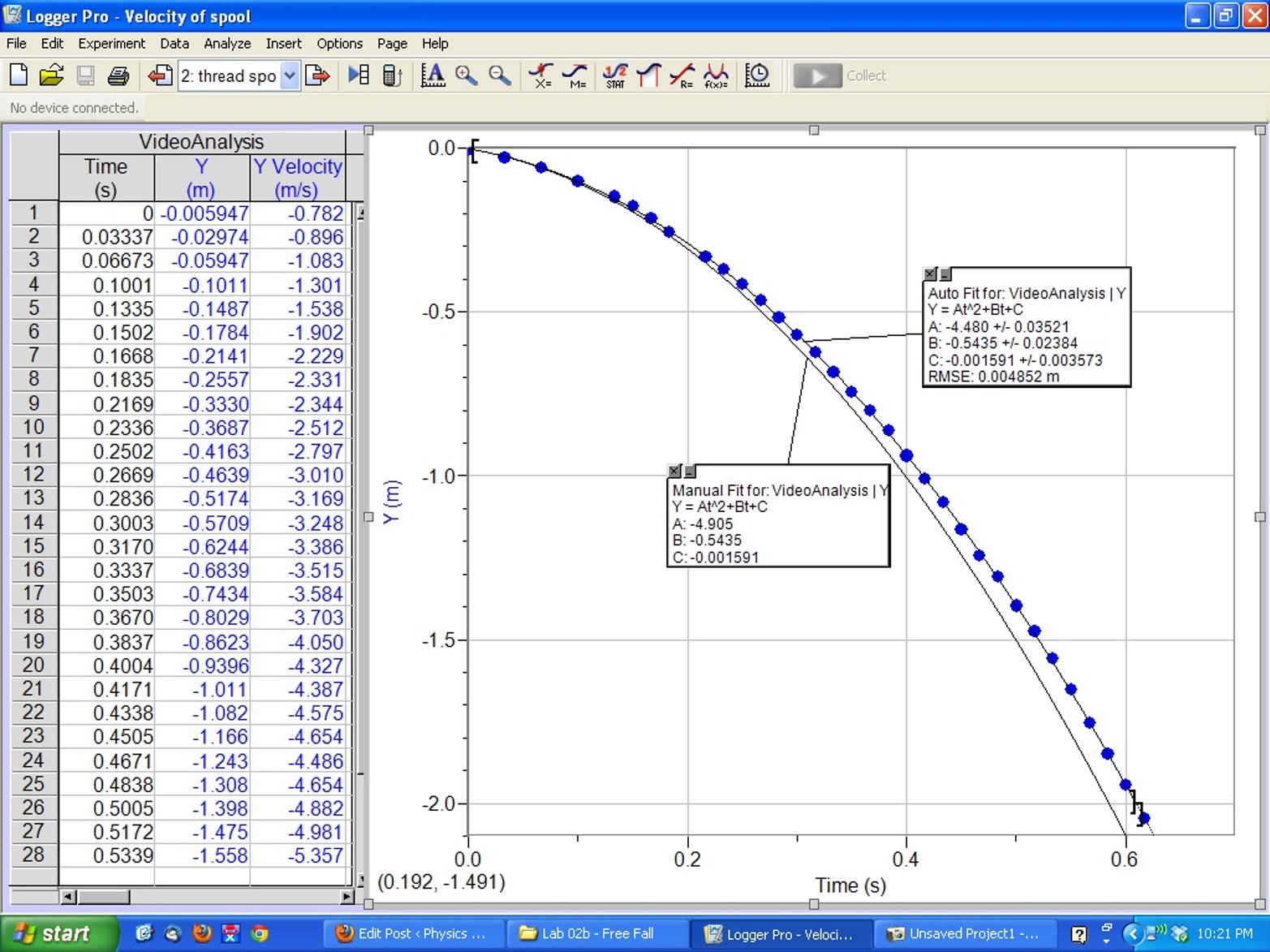
We are using Logger Pro software from Vernier. I suppose you could use Tracker, but I have Logger Pro and know how to use it. In Logger Pro, we insert the movie file and then use the tools to place a dot on the object as it drops. The software advances the frame, and in a few minutes we have a synched up video, graph and data table. The software allows the students to quickly see how the slope of the distance vs. time graph changes. They can replay the image and watch their data points in action.
Click for larger image
I have them use a quadratic curve fit to calculate the actual acceleration. Then the kids create a second curve and override the fit value with g/2. That puts the expected acceleration curve next to the actual. The effects of air resistance are instantly visible.
We just did this lab for the first time yesterday and today. Give the kids time, it’s going to take them a couple class periods to make this all happen. Initial feedback has been good. I think it’s making sense to them. They can see the effects of acceleration. They can clearly see terminal velocity.
Here is the lab they used. I expect there will be some changes.
 A few weeks back, my principle asked me to talk to the faculty about my experience with Standards-Based Grading. Our professional development begins this week and I will be presenting on Tuesday (8/28/12). This is my first public talk on the topic, I hope to present a more refined version of this talk at a conference later this year. The slides aren’t glamorous and it’s a lot wordier than I like, but it feel the PowerPoint needs to stand on its own without me talking over it. I’ll embellish with anecdotes and energy.
There are some comments in the note section on some of the slides, so you probably want to download the slide show rather than just view it directly on Dropbox. I’ve also included an annotated set of spreadsheets that I will be using during the presentation. Hover over the commented cells to see my thoughts on the patterns that show individual student development.
https://www.dropbox.com/sh/s9f2r2jjko65ehs/5ooodjg10L
I would really appreciate any feedback, negative in particular. If you find slides are unclear, confusing, any typos, or if I’m you think I’m missing something, I need to hear from you.
Light in Slow Motion
Posted on: August 26, 2012
My father just sent me this TED Talk. He doesn’t read my blog and didn’t know about the other TED Talks I posted. This one is a little different, Ramesh Raskar from MIT has developed a camera that can slow motion down to the point of being able to see a pulse of light travel. You just have to see it to believe it.
And in case you aren’t seeing the embedded video:
http://www.ted.com/talks/ramesh_raskar_a_camera_that_takes_one_trillion_frames_per_second.html
I Love TED Talks
Posted on: August 14, 2012
I do. They frustrate me a bit because there are just so many and I don’t know most of the speakers. You can spend an evening jumping from one talk to the next. I prefer recommendations, here are two I recommend.
The first talk is by Dan Meyer of the dy/dan blog. His blog was the source I used to get started on Standards-Based Grading. Plain and simple, this talk is an eye opener.
The second TED Talk is by Simon Sinek. His talk was recommended by Frank Noschese at the AAPT meeting. Excellent recommendation Frank.
If you have some favorite TED Talks, please share the link or the name of the speaker.
I’ve been a member of American Association of Physics Teachers for about 6 years now. If you teach physics, please join! The journals and posters alone are worth the tax deductable annual dues. I attended my first AAPT meeting a couple of weeks back. I learned one or two great new things, met some super people, but I was also a bit disappointed.
Let’s get the negative stuff out of the way.
- I’m used to NSTA, so maybe my reference is unfair. AAPT was small, really small for a national conference. I felt like everybody knew each other because it was the same people every year. You could get through the entire exhibit areas in about an hour.
- It also felt like the conference was aimed at college educators. I know the organizers claim it’s not, but I’m giving my opinion here based on attending one day of a much longer conference.
- I had hoped that the talk on video in the classroom would give lots of useful tips; how to integrate video, success at flipping the classroom, etc. Most of the discussion was why video lectures won’t replace colleges.
Now the positives:
- The first timer special and lunch was a great idea. Lunch and the company was terrific, I’m glad I went. The first timer $75 one-day special is a great way to try it out.
- I got to meet some great people, some new, some who I had previously met online (Kathy, Frank). Everybody was warm and there to interact and learn from each other.
- I met local AAPT members who are trying to suck me in to local activities. I am interest, but they always do them on a Friday night and Saturday. I may submit, I do need local physics buddies but I love my weekends.
- Andy Rundquist demonstrated a great use of Jing. He has his students take a picture of their homework, then narrate the work on video. The video is their homework submission. Jing limits them to 5 minutes and when they talk, you can immediately tell if they know what they are talking about. Andy has them do this for every homework, I’m going to use it sparingly. Super idea.
- There is free software out there called Tracker that does video analysis. One cool use was to take a moving object, like a person jumping into the water, identify several points (hands, feet, head) through each frame, and let the software determine the center of gravity and plot the motion. Did I mention free?
- I really like the sessions where there is a new presenter every 10 minutes. Lots of great stuff, and if it isn’t, it’s only 10 minutes until the next one.
AAPT was worth my time, I wish I had done the entire week. It was close enough to home that I was able to take public transportation. Here’s the problem: if you can get your school to pay for you to travel to one national conference, which do you choose – AAPT or NSTA?
For me, it would be an easy choice. NSTA has so much more to offer, so many more strands, talks, exhibitors, and people to interact with. I would love to do both, I don’t see how. I will get involved locally, AAPT is too good of an organization to ignore, they are worthy of our support.


 Physics & Physical Science Demos, Labs, & Projects for High School Teachers
Visitor Comments